

What Happens During a Bunion Treatment Consultation?
A bunion develops when the alignment of the big toe gradually changes, causing the joint at its base to become more prominent. The appearance of the foot is only one part of the evaluation. A detailed assessment can help determine whether conservative measures may be reasonable or whether a surgical discussion is warranted. At Arizona Foot and Ankle Physicians, our team evaluates bunion concerns according to the patient’s individual foot structure and functional needs. For more information, contact us or request an appointment online. We are conveniently located at 11390 E. Via Linda, Ste 102, Scottsdale, AZ 85259.
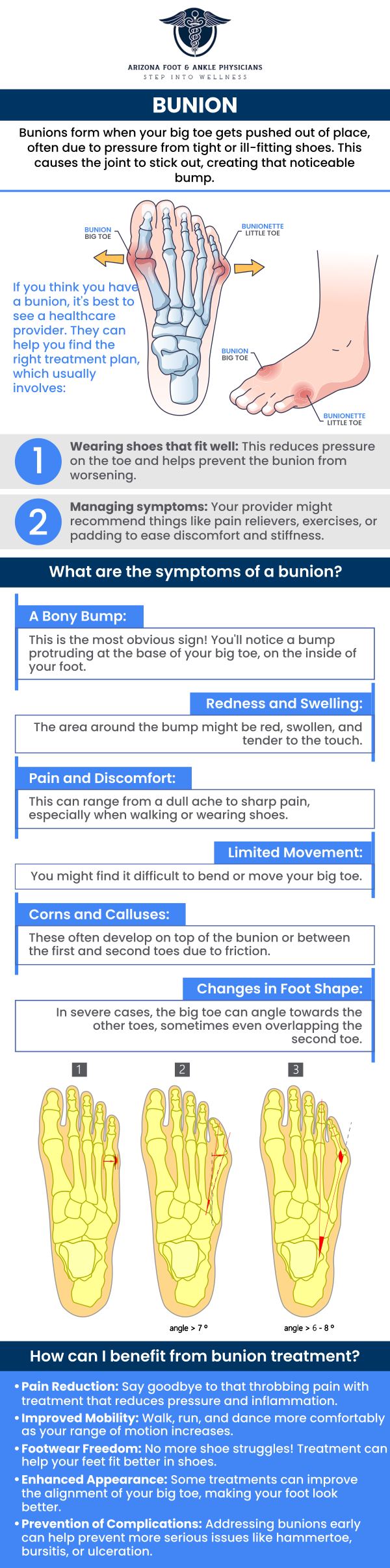
Table of Contents:
What should you expect during an initial bunion treatment consultation?
How does a foot and ankle specialist evaluate a bunion?
What information is reviewed during a bunion assessment?
Why is a personalized approach important for bunion treatment?
How can Arizona Foot and Ankle Physicians provide comprehensive bunion evaluations and treatment guidance based on each patient’s foot health needs?
The first appointment generally begins with a conversation about what you have noticed and how long the problem has been present. You may be asked about discomfort, footwear limitations, changes in walking, previous injuries, prior treatment, and activities that make the foot feel worse.
Our specialist will then examine the foot and may assess the big toe’s alignment, joint movement, areas of tenderness, and overall foot mechanics. Imaging may be recommended when additional information about the bones and joint alignment is needed.
At Arizona Foot and Ankle Physicians, our team uses the consultation to understand the patient’s concerns and determine which evaluation or treatment considerations are appropriate.
Evaluation involves examining both the bunion itself and the way the rest of the foot functions. Our specialist may look at the position of the big toe, prominence of the affected joint, flexibility, skin irritation, and the relationship between the toes and surrounding structures.
Weight-bearing X-rays may be useful because they show the bones under the conditions in which the foot normally supports the body. Imaging can help identify changes in alignment and provide information that cannot be obtained from looking at the foot alone.
At Arizona Foot and Ankle Physicians, our team combines the physical examination with relevant diagnostic information to develop a clearer understanding of the bunion.
A bunion assessment can include details about symptoms, medical history, previous foot problems, activity level, footwear, and treatments already attempted. Our specialist may also want to know whether discomfort is occasional or interfering with walking, work, exercise, or other daily activities.
The physical evaluation provides another layer of information. Foot alignment, joint mobility, pressure points, toe position, and the condition of the surrounding tissues can all influence treatment decisions. When imaging is appropriate, X-rays can provide additional structural information.
At Arizona Foot and Ankle Physicians, our team considers these findings together rather than basing recommendations solely on the size or appearance of the bunion.
Bunions can look similar from the outside while affecting patients quite differently. One person may have little discomfort despite a visible deformity, while another may experience significant pain, difficulty finding comfortable shoes, or problems with normal movement.
Treatment therefore depends on the individual’s symptoms, foot anatomy, activity requirements, and progression of the condition. Depending on the situation, management may involve footwear changes, supportive measures, activity modifications, or surgical correction when appropriate.
At Arizona Foot and Ankle Physicians, our team considers the patient’s goals and clinical findings when discussing the most suitable direction for bunion care.
A comprehensive bunion evaluation should answer more than whether a patient has a visible deformity. Our team looks at how the bunion affects alignment, joint function, comfort, mobility, footwear, and quality of life. When imaging is needed, those findings can be considered alongside the physical examination to create a more complete picture.
Treatment recommendations can then be matched to the severity of the condition and the patient’s circumstances. Patients can receive information about non-surgical management as well as surgical possibilities when the deformity or symptoms warrant that discussion. This individualized process helps avoid recommending the same solution to every patient.
At Arizona Foot and Ankle Physicians, our team provides comprehensive bunion evaluations and individualized treatment guidance based on each patient’s foot health, symptoms, functional needs, and personal goals. For more information, contact us or request an appointment online. We are conveniently located at 11390 E. Via Linda, Ste 102, Scottsdale, AZ 85259. We serve patients from Scottsdale AZ, Fountain Hills AZ, Paradise Valley AZ, Carefree AZ, Rio Verde AZ, and surrounding areas.
Check Out Our 5 Star Reviews


ADDITIONAL SERVICES YOU MAY NEED
• Diabetic Foot Care
• Fungal Nails
• Heel Pain
• Bunions
• Ingrown Toenail
• Achilles Tendon
• Ankle Sprains
• Arthritis Foot
• Athlete’s Foot
• Corns And Calluses
• Crush Injury
• Flat Feet
• Geriatric Foot Care
• Hammertoes

ADDITIONAL SERVICES YOU MAY NEED
• Diabetic Foot Care
• Fungal Nails
• Heel Pain
• Bunions
• Ingrown Toenail
• Achilles Tendon
• Ankle Sprains
• Arthritis Foot
• Athlete’s Foot
• Corns And Calluses
• Crush Injury
• Flat Feet
• Geriatric Foot Care
• Hammertoes


 Send Text
 How May I Help You?